
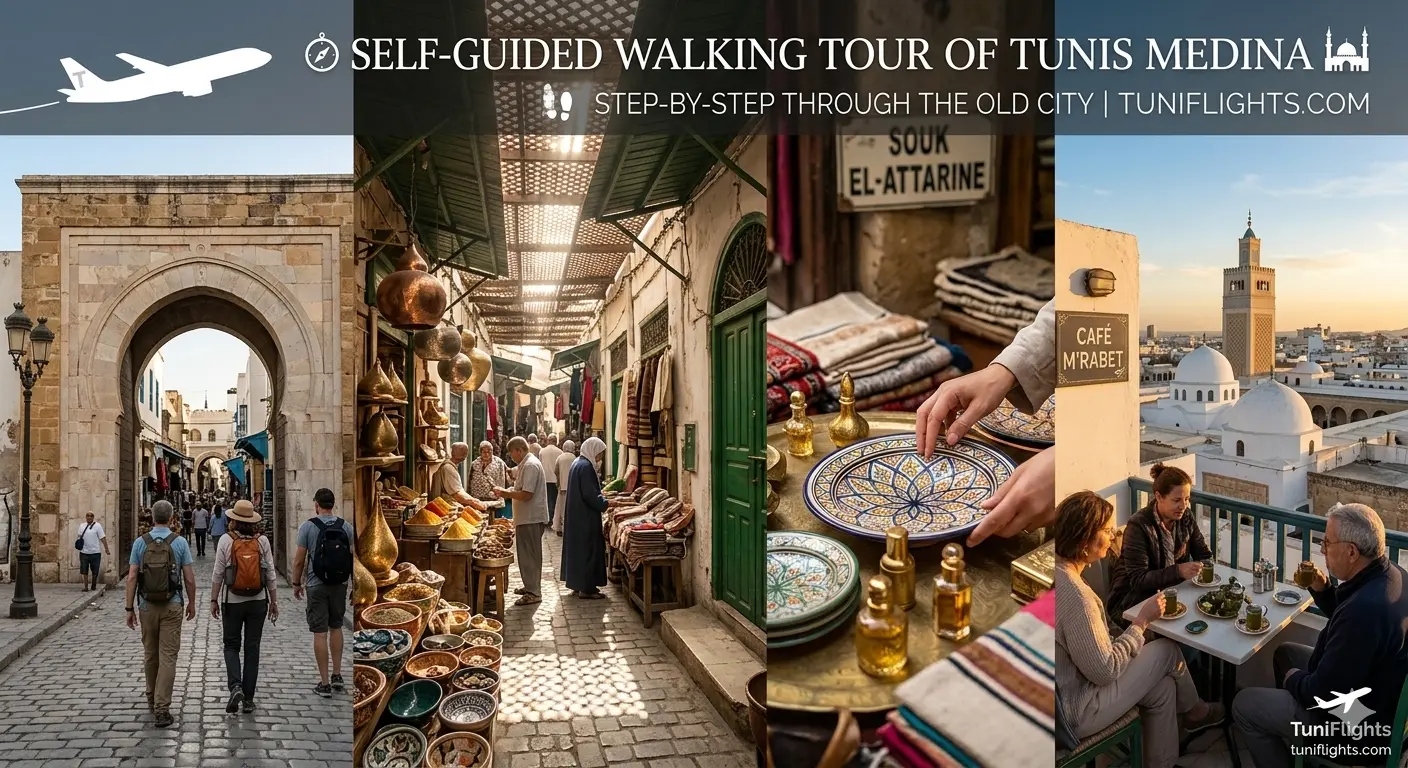
Self-Guided Walking Tour of Tunis Medina
Why the Medina Deserves a Full Half-Day
The medina of Tunis is not the kind of place you should rush through with a single photo stop and a quick mint tea. It is one of the most rewarding urban areas in Tunisia: layered, historic, disorienting in the best possible way, and full of small details that only reveal themselves if you move slowly.
A self-guided visit works very well here because the pleasure of the medina comes from wandering between major landmarks rather than checking off monuments as fast as possible.
Before You Start
Begin in the morning if you can. The lanes are cooler, the light is better, and the rhythm of the medina is easier to enjoy before the busiest shopping hours. Wear comfortable shoes, carry some cash in small notes, and do not over-plan every turn.
The medina is dense but walkable. A half-day route gives you enough time to explore without turning the visit into a forced march.
Stop 1: Bab el Bahr
Bab el Bahr, often called Porte de France, is a natural starting point because it marks the transition from the newer city into the older urban core. Crossing through it gives you an immediate sense of entering a different pace and texture.
Take a few minutes here to orient yourself. The point is not to memorize a perfect route but to notice how quickly the atmosphere changes once you step deeper into the medina.
Stop 2: Around Zitouna Mosque
The Zitouna Mosque area is the heart of the medina and the anchor point for many first-time visitors. Even if your route changes later, this is the central zone you will keep returning to mentally.
The surrounding streets are where the medina feels most alive: trade, movement, prayer rhythms, courtyards, and narrow passages all intersect here. Dress respectfully and observe the atmosphere before you rush to the next stop.
Stop 3: Souk el-Attarine and Nearby Souks
This is where the medina becomes tactile. Perfumes, textiles, metalwork, leather goods, spices, ceramics, and traditional crafts all begin to overlap. You do not need to buy anything to enjoy the experience, but it helps to slow down and actually look at the workmanship instead of treating the souks as background scenery.
The pleasure here is contrast: one lane feels bright and commercial, another feels quiet and almost hidden. Let yourself drift a little.
Stop 4: Historic Houses and Museums
If you want context rather than atmosphere alone, add one historic house or museum stop such as Dar Ben Abdallah. These places help explain how elite Tunisian homes were organized and how urban life functioned inside the medina beyond the shopfronts.
That kind of stop balances the visit well. Without it, the medina can remain beautiful but abstract. With it, the space starts to feel more legible.
Stop 5: A Midday Café Break
A café stop matters. The medina is visually dense, and pausing for tea or coffee helps you absorb what you are seeing. A historic café such as Café M'rabet makes the break part of the experience rather than just a rest stop.
Use that moment to decide whether you want to continue shopping, explore side alleys, or move toward a final viewpoint or exit.
What to Buy and What to Skip
The medina can be tempting if you like crafts, tableware, textiles, perfumes, or small gifts. It is also a place where you should buy with some patience.
Worth considering:
• Ceramics and tableware
• Handmade textiles
• Perfume oils or orange blossom water
• Smaller leather items
Be more cautious with anything that looks generic, mass-produced, or priced as though it were unique when it clearly is not.
How to Handle Navigation
You will probably get a little lost. That is normal, and in many cases it improves the visit. The medina is at its best when you allow a bit of drift between known points.
A good compromise is to keep one or two fixed landmarks in mind while allowing the rest of the route to stay flexible. If you rely entirely on navigation, you may miss the texture. If you rely on memory alone, you may waste too much time.
Etiquette and Practical Tips
A few small habits make the visit smoother:
• Dress respectfully, especially near religious sites
• Ask before photographing people closely
• Carry water, but do not expect every lane to have obvious convenience stops
• Keep your valuables simple and secure
• Approach bargaining calmly, not aggressively
Suggested Timing
A realistic self-guided visit often looks like this:
- 30 minutes to enter and orient yourself
- 60 to 90 minutes around the mosque and souks
- 30 to 45 minutes for a museum or house visit
- 30 minutes for a café break
- Extra time for slow wandering or shopping
That usually gives you a strong three- to four-hour visit without turning it into a rushed checklist.
Final Takeaway
The medina of Tunis rewards curiosity more than speed. The best visit is not the one with the most stops. It is the one where you allow enough time for the medina to feel like a living place rather than a historic backdrop.
If you arrive with comfortable shoes, realistic timing, and the willingness to wander a little, this can easily become one of the most memorable urban walks in Tunisia.